
Mira Tanaka | Based in Austin, Texas
"I don't paint to be seen. I paint to be touched."
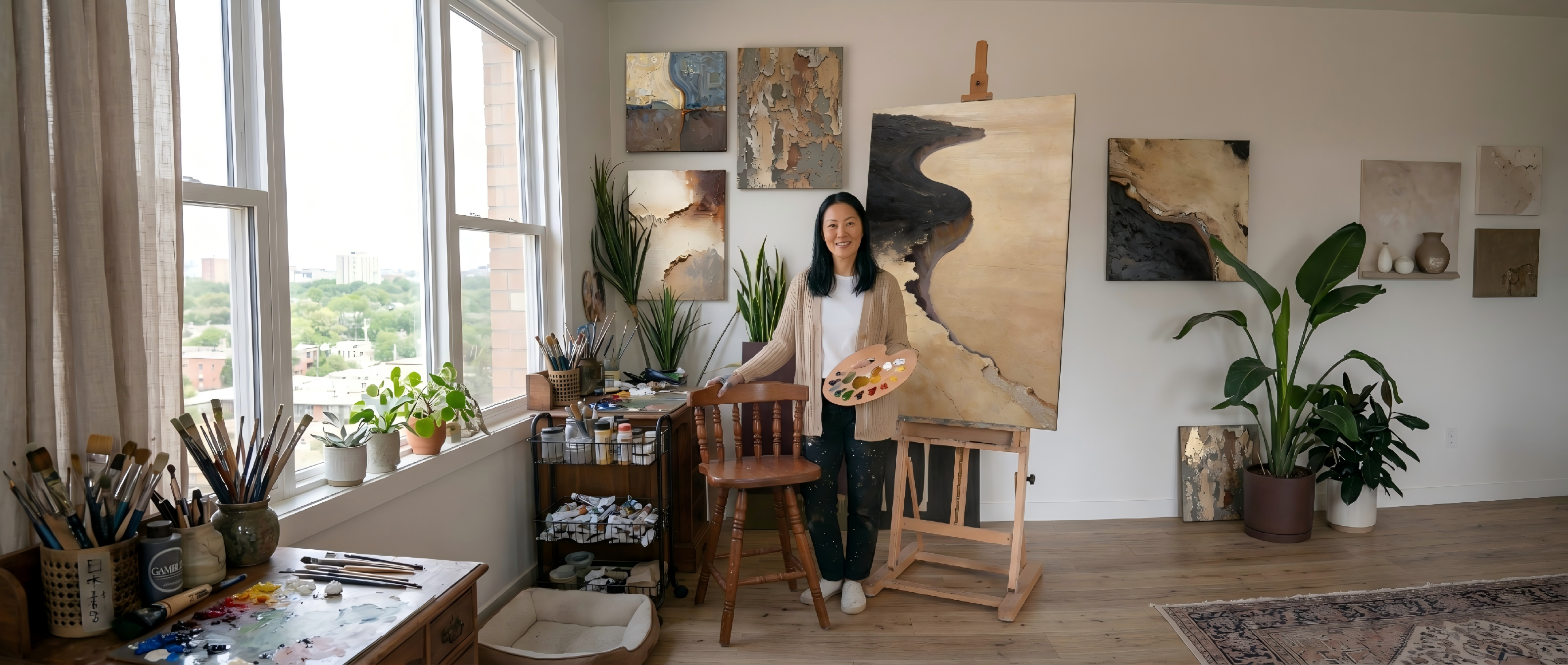
Mira Tanaka has never experienced silence — only selectivity. Born with partial hearing in her left ear, she learned early that the world offers information in more channels than most people bother to notice. Sound was partial, unreliable, sometimes exhausting. Texture was constant. The grain of a wooden table, the weave of a linen napkin, the raised edge of a printed letter — these were the signals her hands learned to read before her ears could keep up.
She didn't come to painting through art school. She came through ceramics. At eighteen, she enrolled in a studio pottery course at a community college in Sacramento, drawn by the fact that clay didn't require hearing — only pressure, moisture, and attention. She was good at it. Her coils were even, her walls consistent, her glazes patient. But she noticed something her instructors didn't: the most interesting part of any pot wasn't the shape or the glaze. It was the surface. The ridges where her fingers had pressed. The accidental texture where a thumb slipped. The moment the clay remembered the hand.
It took her another six years to transfer that insight to canvas. She moved to Austin in her mid-twenties, took a job framing art at a gallery on South Congress, and spent her evenings in a rented garage, teaching herself to paint. The early work was conventional — color fields, soft edges, the kind of paintings that look good in photographs and feel like nothing in person. She was bored by them. Then one night, reaching for a brush, her hand went past it and pressed straight into the paint. The canvas gave. The pigment pushed back up between her fingers. And she felt information she had been filtering out for years — the viscosity of the paint, the tension of the weave, the exact moment when pressure becomes impression.
Her impasto isn't a stylistic choice. It's a sensory translation. Where others paint to be seen, Tanaka paints to be touched. Each ridge and groove in her work is a record of pressure — the weight of her palm pressing pigment into canvas, the drag of a small metal trowel through thick oil paint, the deliberate pause where she lets the material speak before she answers. Her canvases carry the physical memory of every gesture that made them: warm oatmeal grounds built in slow layers, fine linear geometries scratched into half-dry paint, patches where the surface is left raw because the painting told her to stop.
Working from a converted studio in East Austin, Tanaka builds paintings the way a body builds habit — through repetition, adjustment, and the quiet intelligence of paying attention to what's closest. Her palette stays within a single temperature: oatmeal, cream, warm ash, espresso brown, pale ochre. No contrast for contrast's sake. The drama, if there is one, is in the surface itself — in the distance between the highest ridge and the deepest groove, in the way gallery light catches one edge and leaves another in shadow, in the silence between marks that were never meant to be heard.
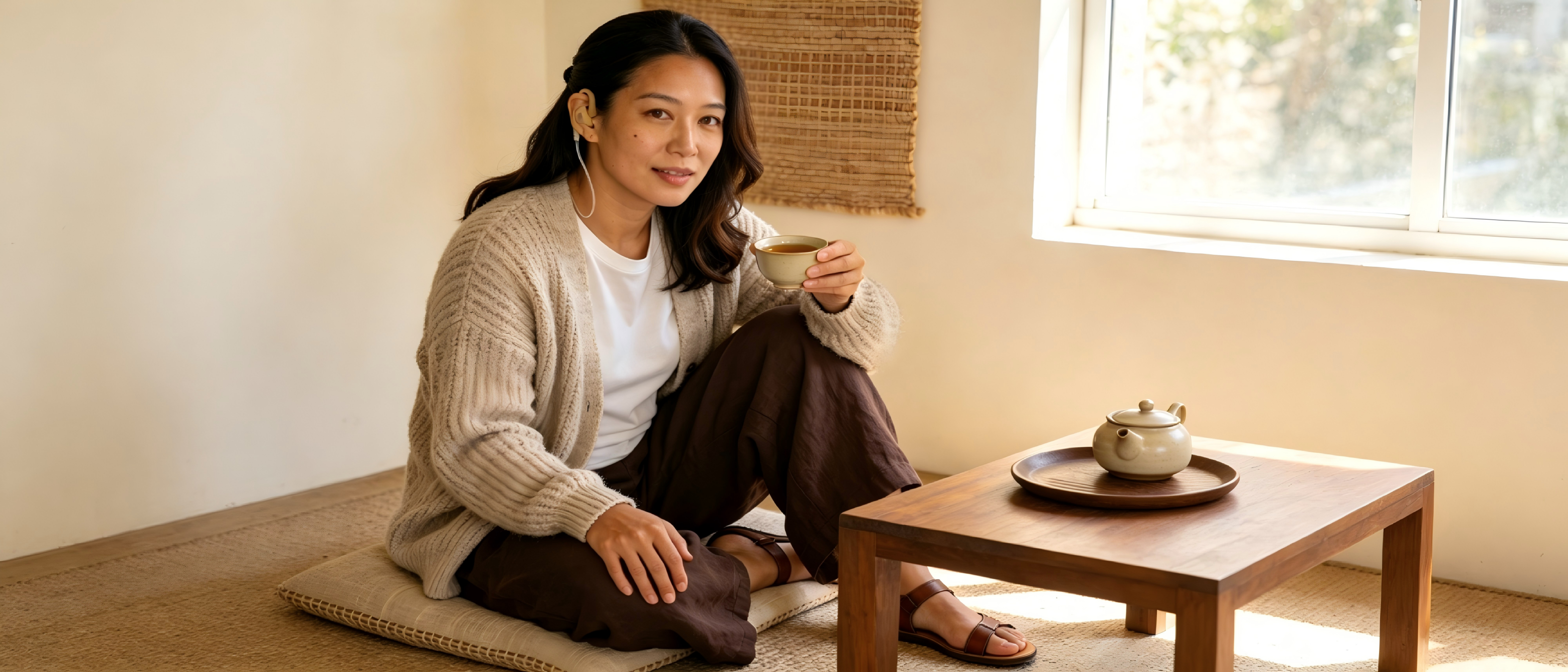
She removes her hearing aid when she works. Not to shut the world out, but to tune into the frequency she trusts most — the one that travels through the hand, not the ear. The canvas vibrates when she presses hard. The trowel hums against dried paint. These are not metaphors. They are the real sounds of her practice, the ones that matter.
Process
Every Tanaka painting begins with the ground.She mixes her base in small batches — oatmeal, cream, warm ash — and trowels it onto unprimed linen in thin, even layers. Not smooth. Never smooth. She wants the weave of the fabric to come through, wants the ground to feel like something worn rather than freshly made. Each layer dries for a day before the next goes on. Three layers, sometimes four. The ground is not a background. It's the room the painting lives in. And like any room, it has to be built right before you can live in it.When the ground is ready, she works in two registers simultaneously. With her right hand, she draws fine linear geometries into the paint — incomplete shapes, lines that start and don't finish, angles that suggest a grid but refuse to complete one. Dozens of them. A triangle missing one side. A rectangle open at the corner. A circle that made it three-quarters of the way around and stopped. The lines are thin — one, maybe two millimeters wide — scratched into the half-dry ground with the edge of a small metal trowel. Not drawn. Scratched. The way you'd draw in sand with a stick. The ground parts and closes around the line, holding it the way soil holds a footprint.With her left palm, she presses thick impasto into specific zones, building ridges that rise a millimeter or two off the surface. The palm-press is her signature gesture: full contact, no brush, the hand reading the canvas as it writes on it. She presses once and lifts. Presses again, slightly offset. The overlapping edges create miniature topographies — small ridges that catch light, shallow valleys that hold shadow. She never goes back to smooth them. The imperfection is the record. It says: a hand was here. It pressed. This is what happened.The two registers coexist but don't cooperate. The fine lines run underneath and through the impasto zones. Sometimes a palm-press covers a line, and that line disappears — not erased, just buried, the way a word disappears under your finger when you run it across a page of braille. Other times, the lines surface between the ridges, visible in the gaps, like something glimpsed through a fence. The painting doesn't resolve these two systems into one image. It holds both. The tension is the work.She works slowly. Not because she's careful — because she's listening. The paint tells her when to stop. A ridge catches light differently at noon than at four. A groove deepens as it dries. She watches these changes the way other people watch weather. She'll walk past a painting a dozen times in a single day, never touching, just observing how the surface behaves as the light moves through the studio. And when the surface has said everything it's going to say — when it stops changing, stops asking, stops answering — she steps back. That's the finished painting. Not when it looks done. When it stops changing.
Studio Visit
Touch. Silence. Edge.
Nothing. I mean that literally and figuratively. My hearing is partial — I wear a hearing aid, and I take it out when I work. The silence isn't absence. It's concentration. I can feel the trowel moving through the paint, I can feel the canvas under my feet vibrating when I press hard. That's enough. More than enough, actually. The studio is the loudest room I've ever been in — it's just loud in a frequency most people don't track.
I was reaching for a brush and my hand went past it. Straight into the paint. I pressed down and felt the canvas give, and the paint push back up between my fingers, and I thought — this is information I was missing. The brush was filtering it out. My hand was the right tool all along. I went back to brushes the next day. Tried for a week. Kept reaching past them. Eventually I just stopped putting them out.
Color is noise. I'm not interested in noise. I'm interested in what happens when you remove everything that distracts from the surface itself. Oatmeal, cream, warm ash — these aren't boring colors. They're patient ones. They wait for the light to change and then they do something different. A red would scream. I want my paintings to hold a room, not command it.
A complete shape is a statement. An incomplete shape is a question. I'm not interested in telling you what to see. I'm interested in giving your eye something to finish — or not. The line that stops three-quarters of the way across is the most honest mark I can make, because it admits I didn't need to go further. The painting didn't need it. So I stopped.
They're two languages spoken on the same surface. The lines are the grammar — the structure, the rhythm, the logic. The impasto is the breath — the pressure, the pause, the body. They don't translate each other. They sit next to each other. Sometimes the impasto covers a line, and you only know it's there because the surface reads differently in that spot. That's fine. I know it's there. The painting knows it's there. You don't have to.
When I walk past it in the morning and I don't want to touch it anymore. That's it. Not when it looks done — when it stops asking me to change it.
The surface. Always the surface. In ceramics, people obsess over the form — the shape of the vessel, the curve of the rim. But the surface is where the kiln speaks. The crackle, the crawl, the accidental deposit of ash. Those aren't mistakes. Those are the kiln's contribution. I learned to respect what the material does when you stop controlling it. I paint the same way. I make the mark, and then I let the paint do what paint does. The cracks, the settling, the way a ridge dries unevenly — that's not me. That's the material. I just set it up.
Not in the way people expect. I'm not painting Austin. I'm not painting Texas. I'm not painting landscape. But the light here matters — the way it comes through my north-facing window, flat and steady, changing slowly. The humidity matters. Paint dries differently here than it did in Sacramento. Faster. Which means I have to work faster with the trowel, which means the lines are a little more urgent. The city is in the work, but it's in the chemistry, not the subject.
Works by Mira Tanaka
-

Index Finger
$379.99 -
 -16%
-16%Earth Tone Geometric Textured Wall Art with Organic Shapes for Living Room
$333.59 $277.99 -
 -16%
-16%Warm Neutral Textured Abstract Wall Art with Flowing Curves for Living Room
$333.59 $277.99 -
 -16%
-16%Earth Tone Geometric Textured Wall Art with Organic Circles for Living Room
$333.59 $277.99 -
 -16%
-16%Minimalist White Textured Abstract Wall Art with Diagonal Lines for Entryway
$333.59 $277.99 -
 -16%
-16%Minimalist White Textured Abstract Wall Art with Organic Curves for Dining Room
$333.59 $277.99 -
 -16%
-16%Soft Neutral Textured Abstract Wall Art in Beige and Blush for Bedroom
$333.59 $277.99 -
 -16%
-16%Neutral Textured Abstract Wall Art in Cream, Taupe and Charcoal for Modern Living Rooms
$298.79 $248.99 -

Vestibule
$242.99 -

Volume
$379.99 -

Braille Cell
$379.99 -

Glossary
$379.99


