
Amara Osei | Based InAsheville, North Carolina
"Each mark is the same prayer. None of them sound alike."
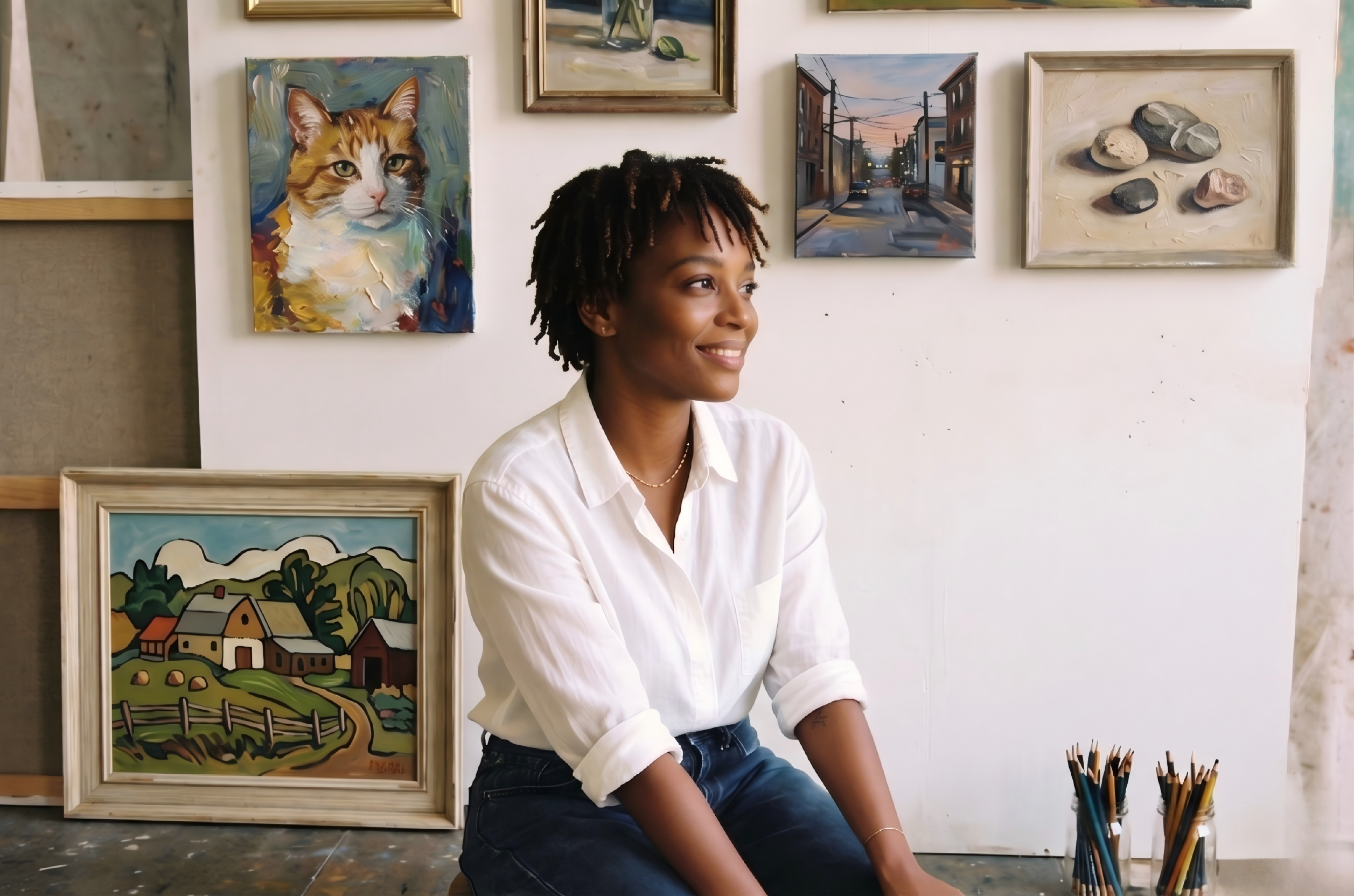
Amara Osei learned rhythm before she learned language. Her grandmother was a kente weaver in Accra — not the ceremonial kind who works in brilliant color for weddings and festivals, but the everyday kind who sat at a loom in the courtyard and passed the shuttle through the warp the way other people breathe: continuously, without thinking, the same motion repeated until it became indistinguishable from living. Amara was four years old when she first sat beside the loom and felt the bench vibrate with each pass. She didn't understand what the cloth was for. She understood that the rhythm was the thing.
She was twelve when her mother moved them to Richmond, Virginia. New country, new accent, new climate. The things that didn't change were the ones she could find in the woods. Virginia hardwood forest in October reminded her of nothing in Accra, but the patience of it — the way a season turns without consulting anyone — felt familiar. She walked trails after school, not hiking, just walking, noticing. She noticed moss first. Then lichen. Then the way lichen colonized a stone so slowly that you could visit the same rock every week for a year and only see the difference if you'd been taking photographs and laying them side by side.
She studied botany at the University of Virginia, then a master's in ecology, then five years of field research on the colonization patterns of moss and lichen communities on abandoned industrial sites across Appalachia. Her thesis advisor thought she was studying succession. She was studying devotion. She would set up a transect on a spoil bank outside a decommissioned iron furnace in southwest Virginia and return every week for three years, photographing the same twenty centimeters of rock face, watching lichen advance by fractions of a millimeter. The work was solitary. Weeks at a time in a field station with no cell service, just her and the rocks and the slow, implacable patience of organisms that measure time in decades.
The turning point came on a Tuesday in February, year three of the iron furnace study. She was crouched on a berm above the ruins, photographing a crustose lichen colony that had nearly covered its host rock, when she recognized what she was looking at. Not the species — she'd identified it in year one. The rhythm. The lichen was doing what her grandmother had done: the same gesture, repeated with absolute fidelity, accumulating into something larger than any single act. Each fungal hypha extending a micron, each algal cell dividing — identical processes, repeated billions of times, each repetition subtly conditioned by its specific moment of occurrence. The colony wasn't a pattern. It was a practice. And the slight irregularities — the gap where a hypha had encountered a mineral deposit and veered, the thinner coverage where runoff had inhibited growth — these weren't defects. They were the record of a living thing negotiating with its conditions in real time. The cloth remembers every pass of the shuttle. The rock remembers every season of rain.
She went back to the field station that night and couldn't write her notes. She didn't want to describe what she'd seen. She wanted to do it. She wanted to take the rhythm in her hands and press it into something. Two weeks later she submitted her resignation. Three months after that she was in Asheville, in a converted garage with a window that looked straight into the Blue Ridge fog, holding a small round brush and pressing it into unprimed linen for the first time.
Her paintings don't look like they were made. They look like they grew. She works with a single brush — a small round sable, number four — and a palette drawn from the forest floor: moss green, lichen silver-grey, mushroom, bark brown, fog white, deep forest. She presses the brush into diluted oil paint and then presses it onto the linen, leaving a soft oval mark three or four millimeters across. Then she lifts, moves, presses again. The same mark. The same pressure. The same interval. Hundreds of times, sometimes thousands, over the course of weeks. Each mark intends to be identical. None of them are. The hand trembles slightly. The pressure varies by fractions of an ounce. The spacing drifts. These deviations are not mistakes. They are the proof that a living hand made each mark, that the prayer was spoken and not recorded, that the rhythm was felt and not programmed.
The marks accumulate in fields — denser toward the center of the canvas, sparser at the edges, with large areas of bare linen visible between. The distribution is not random. It follows the logic of colonization: a beginning, a spreading, a frontier where the marks thin out and the surface underneath shows through. From across the room, the painting reads as a soft field of color — a moss green zone fading into fog. Close up, it resolves into hundreds of individual acts of attention, each one slightly different from its neighbors, the way every leaf on a tree is a leaf and no two are the same.
Working from that converted garage in Asheville, with the Blue Ridge fog pressing against the window and moss cultures growing on the shelves beside her pigments, Osei builds paintings the way her grandmother built cloth — one pass at a time, faithful to the rhythm, trusting that the accumulation will become something she couldn't have planned. She doesn't sketch. She doesn't plan compositions. She begins at a point and works outward, following the logic of the surface the way lichen follows the logic of the stone. The painting tells her where it wants to grow. She follows.

Process
Every Osei painting begins with a single mark.She stretches unprimed linen — medium weight, plain weave — and sets it on the wall at eye level. She loads her brush: a number four round sable, the same one she's been using for years, replaced only when the tip wears flat. The paint is thinned with linseed oil to a consistency between cream and syrup — fluid enough to leave a soft edge, thick enough to hold its shape on contact. She presses the brush to the linen and lifts. One mark. A small oval, three or four millimeters wide, the pigment slightly darker at the center where the bristles concentrated the paint, lighter at the edges where it feathered into the weave. This is the first prayer.She moves an inch or two and presses again. Same brush. Same paint. Same pressure. Same interval. Then again. And again. The marks accumulate the way moss spreads across a stone — not in rows, not in a grid, but in a field that has density and direction. She works from a starting point and radiates outward, following a logic that isn't planned but isn't random either. It's the logic of attention: this spot feels right, press; this spot feels crowded, skip; this spot needs a companion, press twice. She doesn't think these decisions. Her hand makes them the way a weaver's hand finds the shed without looking.The palette stays within a single world: moss green, lichen silver-grey, mushroom, bark brown, fog white, deep forest. These are the colors she sees when she hikes the mountains behind her studio every morning before work — the floor of an Appalachian cove forest in November, a lichen-covered boulder in January rain, the fog that rolls through the gap at dawn and turns everything the color of breath. She mixes her paints in small batches and keeps notes, but the notes are for consistency, not for variation. She wants the green to be the same green. It never is, exactly. The humidity in the studio shifts. The linseed oil ages. The pigment settles differently in the tube. These small inconsistencies are not problems. They're part of the practice — the same prayer, never sounding quite the same twice.A painting takes two to four weeks. She works six to eight hours a day, pressing marks at a rate of roughly one every two seconds. That's eighteen hundred marks an hour. Fourteen thousand marks a day. Two hundred thousand marks in a painting. She doesn't count. The counting would turn devotion into accounting. But she knows the rhythm the way a musician knows a tempo — not as a number, but as a feeling in the body. When the rhythm breaks — when her hand cramps or her attention frays — she stops. Not because the painting demands perfection but because the practice demands presence. A mark made while distracted is still a mark, still valid, still part of the field. But she doesn't want to be absent from it. The devotion isn't in the result. The devotion is in the being-there.She knows a painting is finished when the field has found its shape — when the dense center has established itself, the frontier has thinned to its edge, and the bare linen between the marks reads not as emptiness but as the surface that hasn't been reached yet. The unfinished parts aren't incomplete. They're the future. The stone that lichen hasn't colonized yet isn't bare because the lichen failed. It's bare because the lichen hasn't gotten there. Patience isn't waiting for something to happen. Patience is trusting that it will.
Studio Visit
Press. Repeat. Trust.
Tedious is what you call repetition when you're not paying attention. My grandmother passed the shuttle ten thousand times to make a single strip of kente. I never once saw her look bored. The repetition isn't the obstacle to meaning — it's where the meaning lives. Each press of the brush is a moment of full attention. Or it tries to be. When it isn't, that's visible in the mark — a little too fast, a little too heavy, the spacing off. Those marks are honest. They say: I was here, and I was human, and I got tired. The painting holds all of it.
It's inevitable, and I don't correct it. If I wanted identical marks, I'd use a stamp. The brush, the hand, the breath — they introduce variation whether I want them to or not. The question is what you do with that variation. I let it be there. I don't go back and fix the mark that drifted left, or the one that pressed too hard. Those deviations are the record of a living hand. A grid of perfectly identical marks would be a print. A field of almost-identical marks is a practice. One is mechanical. The other is devotional.
It's the same activity, different medium. When I was in the field, I was watching an organism repeat a single biological gesture — extend, attach, extend, attach — until the accumulation became visible. I was watching devotion in slow motion. The painting is the same thing from the inside. I'm the organism now. The canvas is the rock. And the marks are my hyphae, spreading across the surface, accumulating into something I couldn't have drawn but can only grow.
Because lichen doesn't plan. It lands on a rock and starts growing, and the shape of the colony is determined by the conditions it encounters — a crack, a water trail, a mineral deposit. I work the same way. I pick a starting point — usually where the linen feels most receptive, which is something I can sense but can't explain — and I begin. The composition emerges from the practice. If I planned it, I'd be imposing a shape on the surface. I want the surface to tell me what shape it wants.
It's not a design choice. It's where I live. The Blue Ridge forest floor in autumn is green — not the bright green of spring, but the muted, patient green of moss and lichen growing on stone in deep shade. That's the green I see every morning when I hike. That's the green that goes into the paint. The other painters work from their landscapes — Mira's Texas oatmeal, Ingrid's Norwegian grey, the Vargases' New Mexico earth, Celine's faded walls. I work from mine. Mine happens to be green.
When the frontier feels right. Every painting has a dense center where the marks are close together, and a frontier where they thin out and the bare linen shows through. The frontier is the most important part. Too sharp, and the painting looks like it was cut off. Too diffuse, and it looks like I lost interest. When the frontier reads as natural — like the edge of a lichen colony, where the growth is still happening, still reaching — it's done. The bare linen isn't empty. It's the future. The lichen will get there. Give it time.
I didn't leave science. I changed my methodology. A transect study and a painting are both ways of paying close attention to something over time. The difference is that a transect produces data and a painting produces an object. But the attention is the same. I still walk the same trails. I still photograph the same rocks. I just don't write papers about them anymore. I press them into linen instead.


