
Ingrid Solheim | Based in the Norwegian Coast
"The tremor doesn't ruin the line. It IS the line."
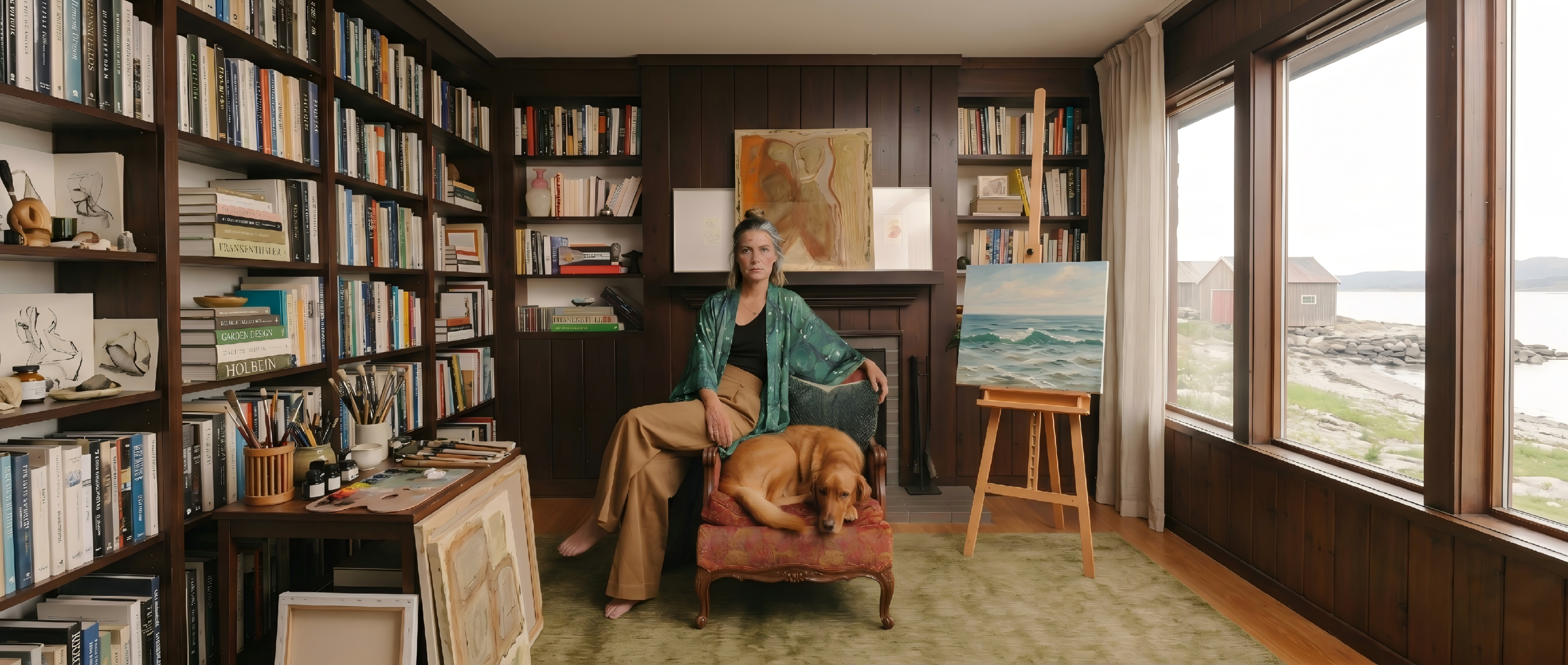
Ingrid Solheim spent eight years painting Scandinavian light with a steady, exacting hand. Fjords in December fog. Birch forests in the grey hour before snow. The particular blue of a winter sea at three in the afternoon. She worked in thin, controlled glazes — the kind of technique that rewards patience and punishes deviation. Her brush barely touched the canvas. The paint sat flat and luminous, like enamel. Galleries in Bergen and Oslo called her precise. Collectors called her disciplined. She called herself a painter who could hold a line without wavering. And then her hand wavered.
She was thirty-two when the tremor arrived. Not suddenly — tremors never arrive suddenly. They'd been there for months, maybe years, too small to notice, too subtle to name. A slight oscillation when she reached for a glass. A faint rhythm in her right hand when she held a brush at arm's length. She thought it was fatigue. Then she thought it was tension. Then a neurologist in Bergen told her it was essential tremor — the most common movement disorder most people have never heard of, and one that has no cure, only management. The doctor was kind about it. He said it wasn't dangerous. He said many people live full lives with it. He didn't say she could keep painting the way she painted.
For six months she tried. Smaller brushes, tighter grips, a wrist brace that locked her hand in position and made the tremor worse because the body knows when it's being fought. The thin glazes started to shiver. The fjords developed a faint stutter at the horizon line. The birch forests looked like they were vibrating — which, she realized with a cold clarity, they were. Her hand was in every stroke now, and not in the way she wanted.
The day she stopped painting was a Tuesday in March. Grey light, wind off the sea, the fishing shed she'd converted into a studio shaking slightly in the gusts. She was standing at her easel, trying to lay a straight horizon line across a small seascape, and her right hand would not hold still. The brush moved in a tiny, regular oscillation — maybe two millimeters, maybe three — just enough to make the line waver like a reflection in water. She put the brush down. She picked up a wide metal palette knife from the table beside her — the one she used for mixing, not painting — and she pressed it into a pile of lead white paint on her palette. Then she pressed it into the canvas. Full arm weight. The knife dragged through the paint, leaving a ridge that rose off the surface like a wave frozen mid-break. The ridge was not straight. It trembled, slightly, rhythmically — the same rhythm as her hand. But at this scale, at this pressure, the tremor wasn't a defect. It was a texture. It was information.
She stood there for a long time, looking at that ridge. Then she pressed again. And again. Each ridge carried the memory of her hand's movement — not the controlled line she used to make, but the real line, the one her body makes when it stops pretending it can hold still. By the end of that afternoon, the seascape was gone under an inch of impasto, and Solheim had found something she'd spent eight years looking for without knowing it: a way to make the painting hold the truth of her body.
She never went back to thin glazes. She never went back to brushes.
Her sculptural impasto — sometimes raised two, three millimeters off the canvas — is built with palette knives, bare palms, and the full weight of her body pressing into the paint. She braces her forearm against the canvas edge to steady her hand, not to eliminate the tremor but to channel it. The ridges she produces are never uniform. They rise and fall in a cadence that mirrors the oscillation of her grip — visible, physical, unapologetic. When gallery light crosses the surface, each ridge casts a small shadow on one side and a highlight on the other. The painting changes throughout the day as the light moves. Morning reveals one set of textures. Afternoon reveals another. By evening, the shadows have shifted again and the surface reads as something entirely different. This is not an accident. It is architecture.
Working from the same converted fishing shed on the Norwegian coast, where wind and salt air seep through the walls and the north-facing window pours cold, diffused light across her work table, Solheim builds paintings that function less like images and more like instruments — devices for registering light, recording pressure, and making imperfection not just visible but structural. Her palette stays within a single temperature: grey-blue, sea grey, driftwood, bleached oak, cold oatmeal. No warmth for warmth's sake. The depth is the drama — the distance between the highest ridge and the deepest groove, the way shadow pools in a trough of paint and disappears when you shift your head three inches to the left.
For Solheim, depth is not decoration. It is documentation. Every ridge is a record of a hand that moved the way it moved, on the day it moved, under the light that was there. The painting doesn't correct the tremor. It preserves it. And in preserving it, it transforms a condition that most people work to hide into a method that produces something no steady hand ever could.
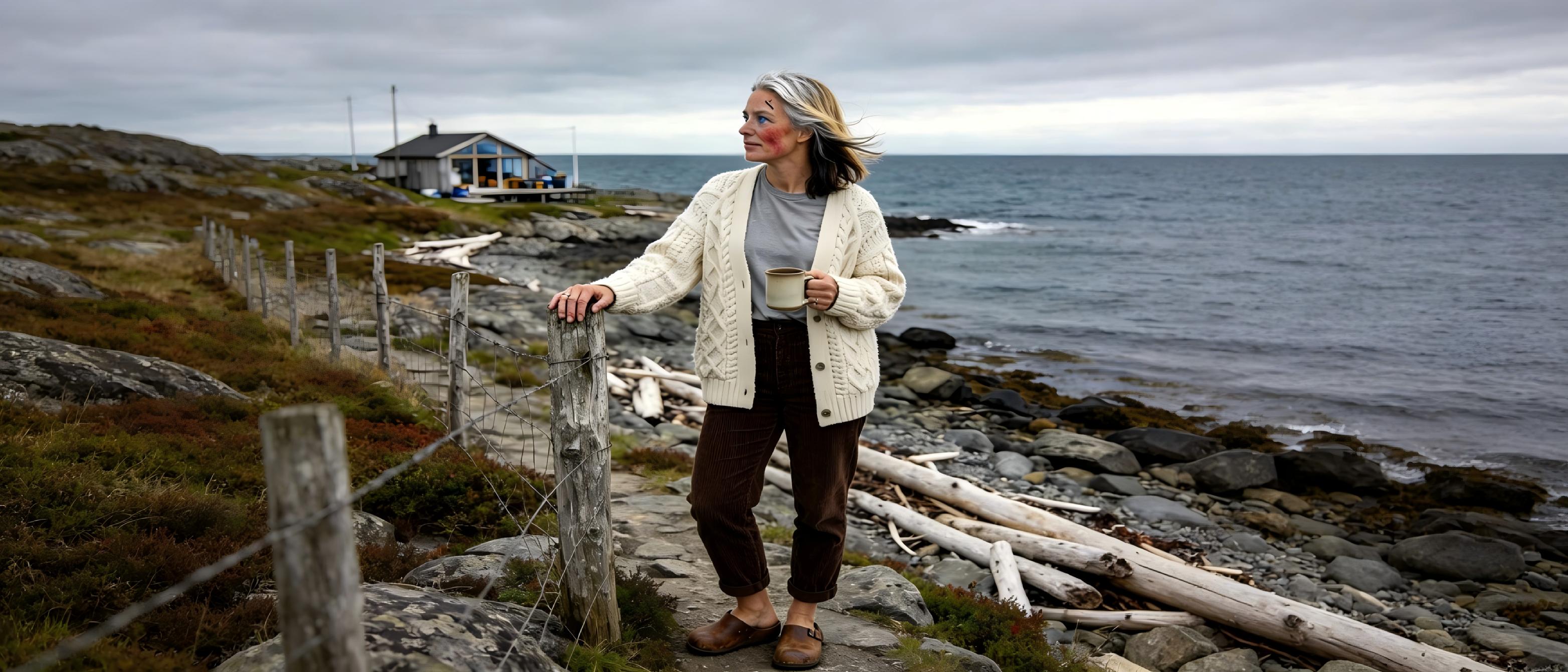
Process
Every Solheim painting begins with pressure, not composition.She doesn't sketch. She doesn't plan. She stands in front of a blank canvas — usually unprimed linen, medium weight, the kind that holds a ridge without collapsing — and she picks up a knife. Not a small one. A wide metal blade, ten or twelve centimeters across, the kind house painters use for scraping. She loads it with paint — thick, straight from the tube, thinned only slightly with linseed oil — and she presses it into the canvas with her full arm weight. Not a gesture. A commitment. Her forearm braces against the canvas edge, her shoulder drops, and the knife moves through the paint like a plow through soil. The ridge it leaves behind rises off the surface immediately. Two millimeters. Sometimes three. The paint is that thick.The first ridge dictates everything that follows. She reads it the way a stonecutter reads a fault line — looking for the grain, the direction, the natural tendency of the material. Then she presses again, parallel to the first, with enough offset that the two ridges form a narrow channel between them. Then a third. A fourth. She works in passes, building a topography of ridges and grooves, each one responding to the one beside it. The spacing is never mechanical. Her hand sets the rhythm, and the rhythm carries the tremor — a slight, regular variation in the height and width of each ridge that makes the surface breathe. A machine would produce uniform ridges. Solheim's ridges are alive. They remember the hand that made them.When the base topography is established, she switches to smaller tools. A narrow knife for fine ridges — the ones that catch light like wire. A wooden dowel for pressing channels — the ones that hold shadow. Her bare hands for the areas where she wants the paint to behave unpredictably, where she wants the surface to carry the imprint of a palm, a knuckle, the edge of a thumb. She presses once and lifts. The paint stays where the hand shaped it. She never smooths. Never corrects. The first mark is the truest mark, because it carries the least intention and the most instinct.Her palette is restricted by conviction, not limitation. Grey-blue, sea grey, driftwood, bleached oak, cold oatmeal — a single temperature family, cold-neutral, derived from the coast outside her window. She mixes each batch by eye, adding raw umber or titanium white in small increments until the color matches the light she's working in. The color is never the subject. The surface is the subject. The color exists to serve the surface — to distinguish one ridge from the next, to make the shadow readable, to give the eye something to follow as the light moves. A painting that reads as a single flat grey from across the room reveals six distinct tones when you stand close enough to see the ridges catching light at different angles. That distance — between the first read and the second — is where the work lives.She works in the morning. The north light is most consistent before noon, and she needs consistency because the painting is a record of light as much as it is a record of pressure. She stops when the light shifts. Not because she can't see — because the painting would become a record of a different day, and she wants each session to be coherent. A painting might take four mornings. It might take twelve. The duration isn't the point. The point is that every ridge on the surface was made under the same conditions, by the same hand, carrying the same tremor. The painting is a document. It documents one body, one window, one stretch of coast, one season of light.
Studio Visit
Ridge. Shadow. Weight.
I miss the fantasy of control. The idea that my hand could hold a line perfectly still — that was the fantasy. The reality was that my hand was always moving. I just trained myself to pretend it wasn't. When the tremor made pretending impossible, I had a choice: stop painting, or start telling the truth. I chose the truth. The knife doesn't lie. It records exactly what the hand does. It turns out what my hand does is more interesting than what I was telling it to do.
It's not a feeling, exactly. It's a rhythm. Like a very small engine running inside my forearm. When I brace against the canvas and press the knife in, the tremor travels through my arm into the blade and into the paint. The ridge records it — a slight wavering in the height, a faint oscillation in the edge. You'd never see it from across a room. You have to stand close and let the light catch it. Then you see it. The ridge breathes.
The coast is the answer and the question. I look out that window every morning and I see grey-blue sea, grey sky, driftwood on the rocks. That's not a limitation — that's a vocabulary. The colors I use are the colors of this place. They're not decorative. They're structural. A grey-blue ridge next to a driftwood ridge reads differently than two grey-blue ridges. The small temperature shift is enough to create depth, shadow, distance. I don't need red. Red would be a visitor. These colors live here.
The building is a collaborator. The walls leak wind. The floor is concrete and the paint that drips on it stays there — I've never cleaned it, and the strata of old paint on the floor probably tells a more accurate history of my practice than any studio visit could. The north window gives me the same light that gives the coast its particular flatness — no direct sun, no harsh shadows, just this even, diffuse illumination that makes every ridge on the canvas announce itself. If I painted in a white cube, the work would be different. The wind comes through the walls and the paint dries faster on the side facing the window. That asymmetry is in the work. I don't correct it.
When I walk past it and the shadows have stopped surprising me. A new painting — a good one — will catch me off guard for days. The light shifts, a ridge throws a shadow I didn't expect, and I think, "I didn't know you could do that." When that stops happening — when I've learned everything the surface has to teach me — it's done. Usually takes a few weeks. Sometimes a month. I never rush it. The painting is patient. I can be patient too.
It's the natural scale of my method. I press with full arm weight. The knife is wide. The paint goes on thick. Two to three millimeters is what that pressure produces. I could build it higher — four, five — but then the painting becomes about the protrusion, not the light. At two or three millimeters, the ridges are subtle enough that you have to stand close to register them. You have to lean in. You have to want to see. That distance — the distance between noticing and understanding — is the whole point. The painting doesn't shout. It waits for you to come closer.
I used to. In the first year, I thought about it constantly. I'd look at a ridge and think, "If my hand were steady, this would be straight." And then one morning I looked at a painting I'd done before the diagnosis — one of those thin glaze fjords, perfect and flat — and I realized I couldn't feel anything looking at it. It was beautiful and dead. The ridges are alive. They move when the light moves. They carry a body's history. A straight line is a statement. A trembling line is a confession. I'll take the confession.
Of a specific body in a specific place on a specific day. That's all. Nothing more, nothing less. The ridge doesn't represent the tremor — it records it. There's a difference. A representation is an interpretation. A record is a fact. This ridge was made on a Tuesday in January, in a fishing shed on the western coast of Norway, by a woman whose right hand oscillates at roughly six to eight hertz when she presses forward. That information is embedded in the paint. You can read it if you know how to look. Most people don't need to know. They just need to feel that the surface is honest. And it is. It's the most honest thing I've ever made.
Works by Ingrid Solheim
-
 -16%
-16%Minimalist Textured Mountain Wall Art in Beige and Charcoal for Living Room
$333.59 $277.99 -
 -16%
-16%Neutral Textured Abstract Wall Art with Flowing Lines for Entryway
$333.59 $277.99 -
 -16%
-16%Abstract Earth Tone Landscape Wall Art with Layered Texture for Entryway
$333.59 $277.99 -
 -16%
-16%Layered Mountain Textured Wall Art in Earth Tones for Living Room
$333.59 $277.99 -
 -16%
-16%Neutral Textured Abstract Wall Art in Beige and Cream for Modern Entryways
$333.59 $277.99 -
 -16%
-16%Textured Abstract Mountain Wall Art in Ivory, Taupe & Charcoal for Living Room
$333.59 $277.99 -
 -16%
-16%Warm Neutral Textured Abstract Wall Art with Flowing Lines for Living Room
$333.59 $277.99 -
 -16%
-16%Neutral Textured Abstract Wall Art in Cream and Beige for Modern Living Rooms
$333.59 $277.99 -
 -16%
-16%Neutral Textured Coastal Abstract Wall Art in Beige and Soft Blue for Modern Living Rooms
$333.59 $277.99 -
 -16%
-16%Neutral Textured Wall Art for Living Room, Beige Wabi Sabi Abstract Painting
$333.59 $277.99 -
 -16%
-16%Crosscurrent – AEVART Wabi-Sabi Impasto Oil Painting on Canvas
$289.19 $240.99 -

AEVART Custom Pet Oil Painting on Canvas
$289.99


