



Sear
Tax included. Shipping calculated at checkout

Free Global Shipping · No Extra Tax

30-Day Return

Handmade

Sustainable Materials
About Sear
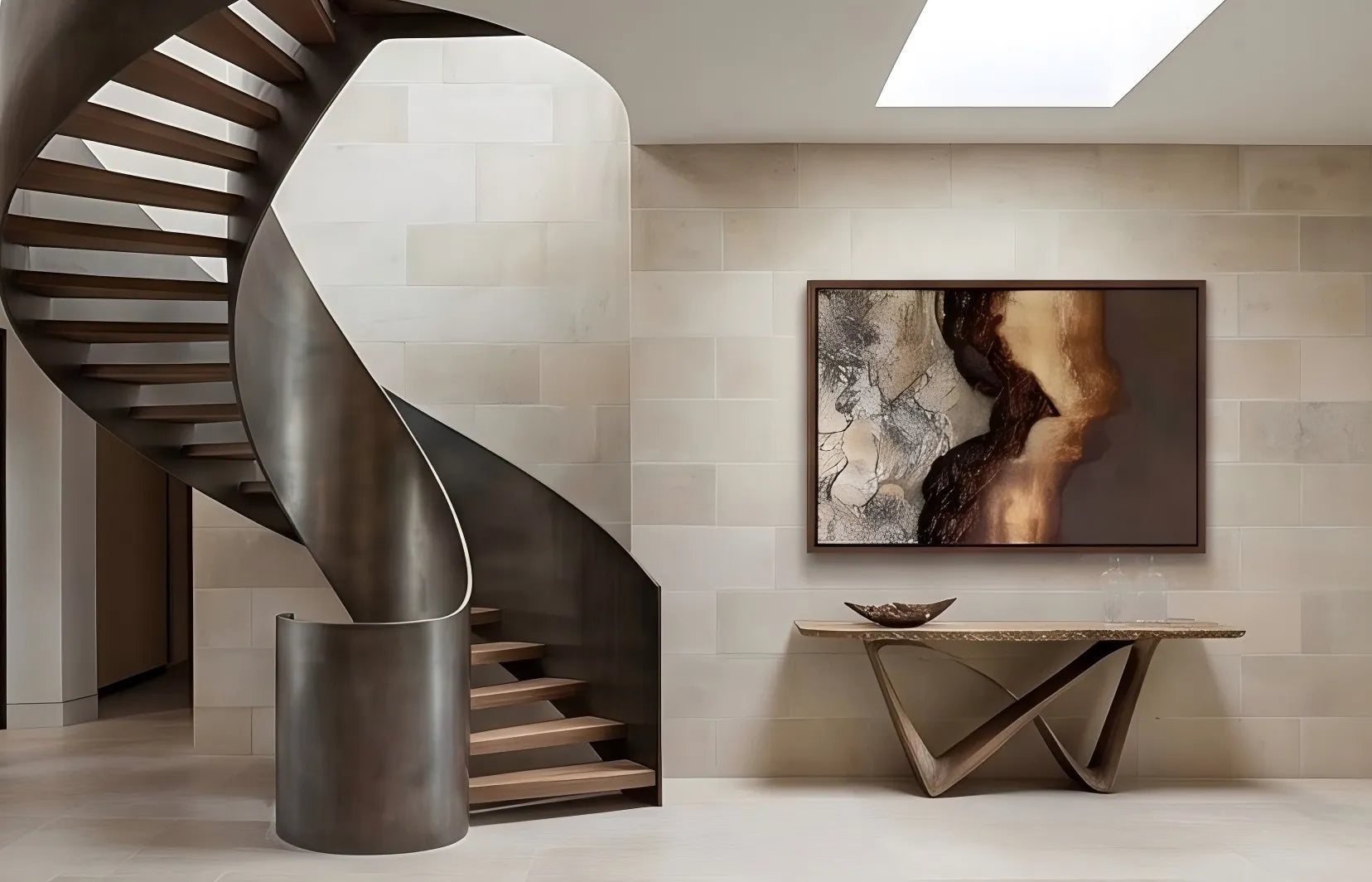
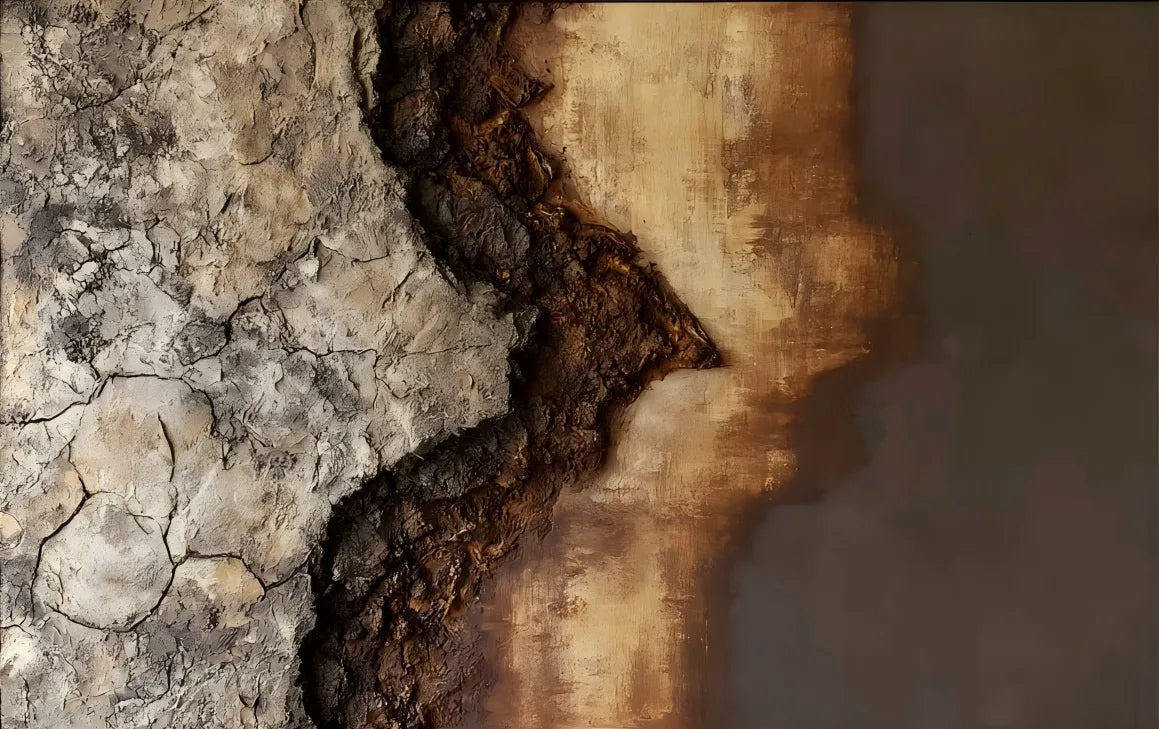
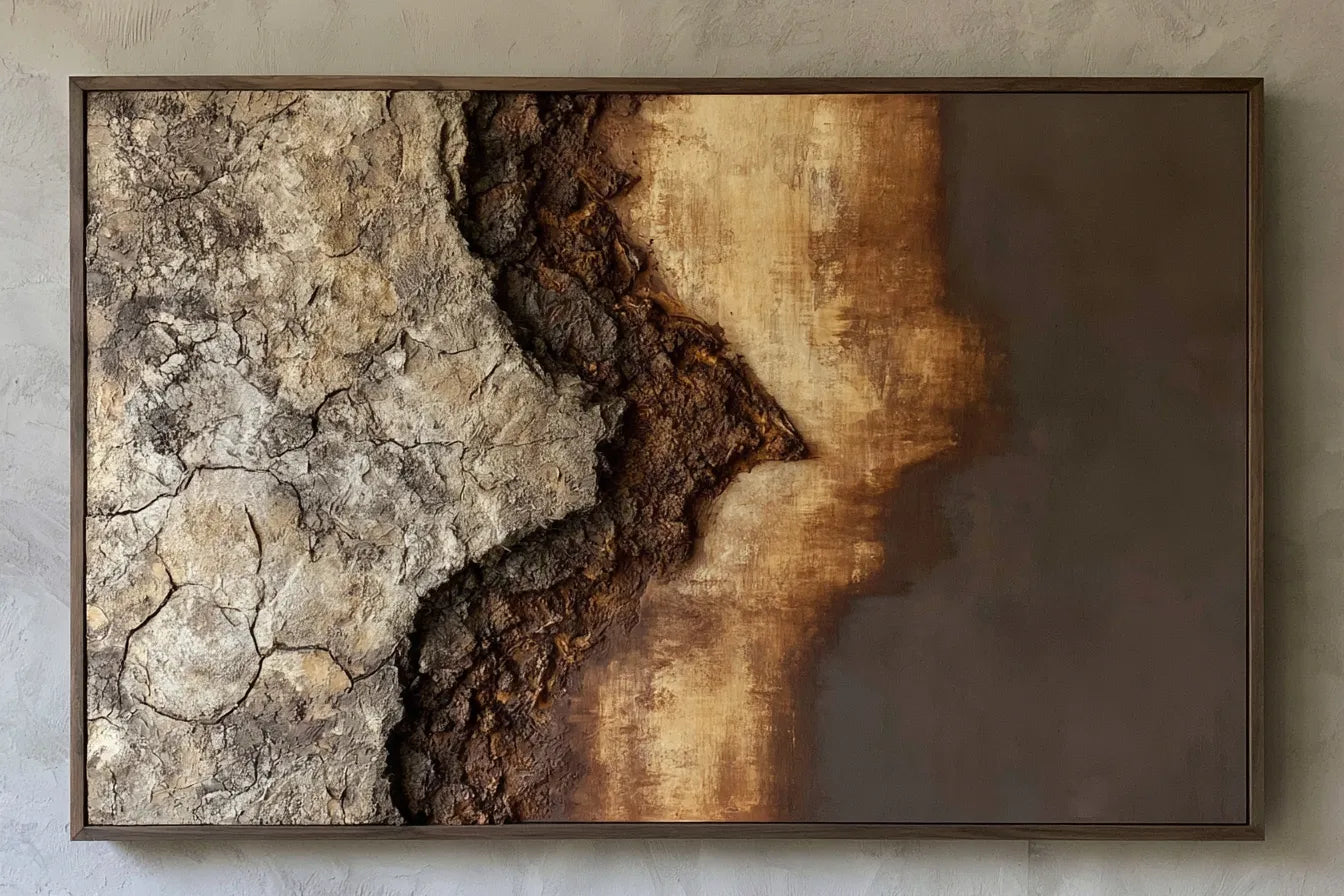
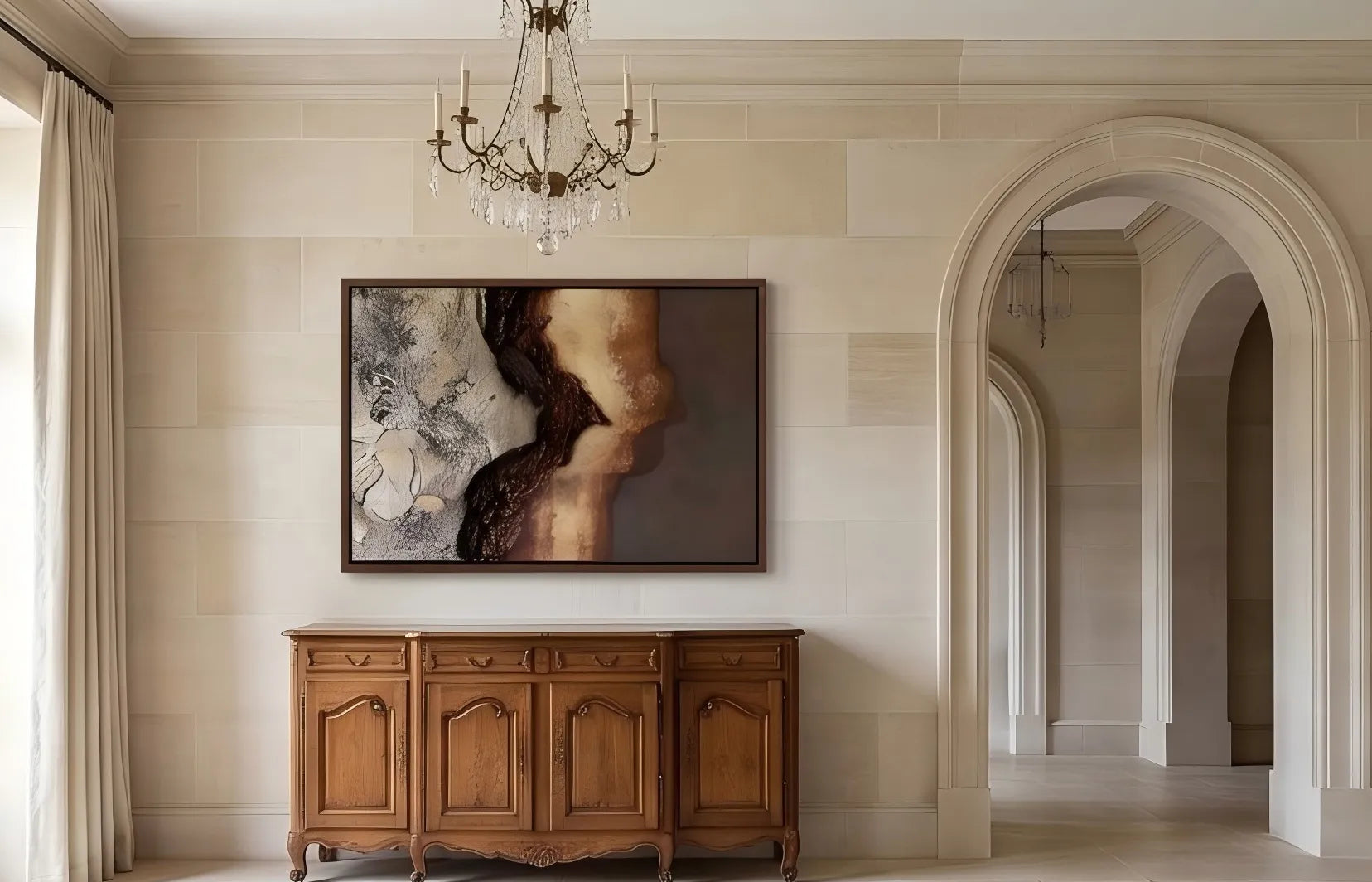
| There is a temperature at which beeswax stops being a surface and becomes an event. I know this temperature the way a printer knows the exact pressure at which paper tears ― not from a manual, from being there. Beeswax melts at a hundred and forty-four degrees Fahrenheit. It begins to carbonize ― the propolis and the damar resin cooking past their tolerance ― around three-fifty. Between those two numbers, the wax behaves. It fuses. It flows. It accepts pigment. It sets into a surface you can trust to hold its shape and its color for a thousand years. That is the promise of encaustic. That is what brought me to it: permanence through simplicity. Heat the wax. Apply the wax. Let the wax cool. The trace is fixed. Move on. Above three-fifty, the wax stops behaving. And this painting lives above three-fifty. The left third of the panel is what happens when you bring the torch close enough and hold it long enough that the surface can no longer pretend it is intact. Encaustic is built in layers ― twenty, sometimes thirty layers of pigmented wax, each one fused to the one beneath with heat, each one cooling and hardening before the next is applied. That layering gives the surface its structural integrity: each layer supports the ones above it, each layer is bonded to the ones below it, and the whole thing holds together the way sedimentary rock holds together ― not because it is one substance, but because it is many substances that have agreed to coexist. Heat breaks that agreement. When the torch passes too close, the top layers soften faster than the layers beneath can accommodate. The surface contracts as it cools ― but unevenly, because the heat was uneven, because my hand moved, because the damar resin and the beeswax cool at different rates, because nothing in this world cools uniformly. And so the surface cracks. Not in straight lines. In a network ― a mosaic of irregular fragments still attached to the panel but no longer attached to each other. Craquelure. The same word they use for fifteenth-century oil paintings and Roman frescoes. The surface has failed in the most fundamental way a surface can fail: it has lost its continuity. Some fragments are darkened. Not from dirt ― from heat. The propolis, the damar, the pigment particles I mixed into the molten wax months ago ― they have been cooked. The chemical term is pyrolysis: thermal decomposition at elevated temperatures. What you are seeing is not charcoal. It is the ghost of what the wax was before the heat changed it. The near-black patches are where carbonization penetrated deepest. The amber glow at the edges is where the heat was intense enough to darken the wax but not intense enough to destroy it. That amber is the wax saying: I survived, but I am not the same. I used to avoid this. Fifteen years of letterpress printing taught me that control is the craft. You set the pressure. You set the ink. You maintain those parameters with religious precision. Deviation is defect. A scorched sheet goes in the waste bin. You do not celebrate the accident. You eliminate it. But I am not running a press anymore. And the longer I work with wax, the more I understand that the defect is the testimony. The crack is not a failure of the surface. It is the surface reporting what happened to it. The carbonization is not damage. It is evidence. I applied heat. The heat changed the wax. The wax recorded the change. That record is the painting. The center band is where the testimony gets complicated. I embed things in wax ― press blanket fibers, paper fragments, lead rules. The detritus of fifteen years running a Heidelberg Windmill. These are not decorations. They are artifacts, sealed inside the panel the way insects are sealed in amber. In this painting, the fragments in the center were cotton fibers ― the pale threads that accumulate between the rollers and the tympan of a printing press. I pressed them into the warm surface, and the wax accepted them, surrounding each fiber with a thin film of amber. When the torch came through, those fibers did not stand a chance. Cotton burns at four hundred and ten degrees. The wax around them was already above three-fifty ― already carbonizing, already losing its composure. The fibers ignited inside the wax. Not a visible flame ― not enough oxygen inside the panel. But they charred. They twisted. They contracted and expanded as the heat fluctuated, and the wax around them moved with them, creating the tangled, knotted texture you see now. What was orderly ― parallel fibers pressed flat into a warm surface ― became chaotic. The heat did not just damage the surface. It rearranged the interior. It took the artifacts I had carefully placed and made them unrecognizable. And that is the most honest part of this painting. Those fibers were witnesses ― they were there when I was running the press, absorbing the ink and the pressure and the vibration of ten thousand impressions a day. I embedded them in wax to preserve their testimony. Then I applied heat so intense that their testimony was distorted ― not erased, but warped, twisted, made strange. The fibers are still there. They are still testifying. But what they are saying now is not what they said before the torch passed. The heat rewrote their story. The right third is where the heat never fully arrived. The surface is intact ― smooth, layered, the way encaustic is supposed to look. The color deepens from left to right because the heat that cracked and carbonized the left side radiated outward, warming the right side enough to shift its tone but not enough to break its structure. The darkness on the far right is not carbonization. It is the natural color of the wax layers in shadow, undisturbed. This is the control. This is what the surface looks like when I restrain myself. When I treat the wax the way I used to treat paper on the press ― with precision, with the understanding that the material has limits and those limits are not suggestions. The left side is what happens when I stop respecting those limits. When I bring the torch close enough to hear the wax hiss. When I hold the heat long enough to watch the surface crack and darken and open. When I let the material do what it wants to do instead of what I want it to do. I am not being reckless. I am being honest. Because the wax wants to do this. Given enough heat, any encaustic surface will crack, will carbonize, will distort. The only thing preventing it is my restraint ― my decision to keep the torch at a distance, to apply heat only until the layers fuse, to stop before the surface starts reporting what it is experiencing. This painting is what happens when I do not stop. |
The AevArt Bespoke Promise
No duplicates, no shortcuts. Every painting we create is a dedicated commission, meticulously hand-painted to align with your aesthetic. We take the time necessary to ensure that your the vision behind it.
Hand-Painted from Scratch: Every piece is created by hand from start to finish.
Artist Signature: You may request the artist's signature on the front (lower right corner) as a mark of authenticity.
Premium Materials: We use professional-grade oil and acrylic paints on heavyweight linen canvas.
As our artist works on your painting, you get front-row access:
Progress Updates: We send you photos and videos of your exact order during the process.
Shipping & Logistics
Timelines & Delivery
We handle the logistics so you can focus on the art. Our total delivery window is 10–16 business days.
Step 1 | Creation & Drying: 5–8 Business Days
Step 2 | Shipping & Transit: 5–8 Business Days
Estimated Total Delivery: 10–16 Business Days
Air Shipping: Delivered via FedEx, DHL, or USPS for a fast and reliable experience.
Sea Shipping: Expertly arranged for large-scale items to prioritize safety and efficiency.
Important: We cannot deliver to PO Boxes or Military addresses (APO/FPO/DPO). Please provide a physical street address to ensure successful delivery of your artwork.
Shipping Fee: Free Shipping to the United States on every order.
International Orders:The final settlement price includes full shipping costs.(costs.Calculated at checkout)
Customs Duties: Please note that once your order arrives in the country of destination, local guidelines apply and your order may be subject to import taxes and local duties. These taxes and duties are not included in your purchase price and are the responsibility of the customer. However, if applicable, we will support with any communication of information with customs as necessary.
Packaging: Rolled (Frameless): Shipped in a reinforced paper tube.
Gallery Framed: Encased in a solid wood frame and protected by a custom-built wooden crate.
Returns & Exchanges
30-Day Satisfaction Guarantee
"Love your art, or send it back within 30 days."
Returns Policy
You have 30 calendar days from the date you receive your artwork to request a return and get a FULL refund.
Standard Artworks: Eligible for the 30-day full Returns AND Exchanges policy.
Custom Orders: Fully personalized custom orders are non-refundable unless they arrive damaged during transit.
Damaged Art If your piece arrives damaged, email support@aevart.com with:Your Order Number Photos of the damaged art & packaging Solution: We provide Priority Repainting (5–8 business days) or a Full Refund.
Need help? Just contact us at support@aevart.com or log in to your account to get started.
Choose options

Free shipping within the US

30 Days Refund

Handmade

Eco Friendly
About Artist

"The groove wasn't carved by the stone. It was carved by the stone's refusal to stop moving."
Artist Recognition
Hand-Painted
No duplicates, no shortcuts. Every AevArt piece is a labor of love, guaranteed to be hand-painted from scratch: Every piece is created by hand from start to finish. No prints, no machines—just the rich texture and soulful essence of artisan craftsmanship.

Secure & Timely Shipping Assurance
We handle the logistics so you can focus on the art. Once your bespoke artwork is completed and stabilized (Step 1 | Creation & Drying: 5–8 Business Days), we partner with premium carriers including FedEx, DHL, or USPS for a fast and reliable experience.
Your masterpiece will arrive at your doorstep within 5–8 Business Days of dispatch (Step 2 | Shipping & Transit), ensuring a smooth, 10–16 Business Days total journey from our studio to your home.

Easy to hang
For all framed orders, your artwork arrives ready for immediate display.We pre-install professional hanging hardware to support both vertical and horizontal orientations. We also provide all necessary tools, allowing you to showcase your new piece with ease and absolute security.