
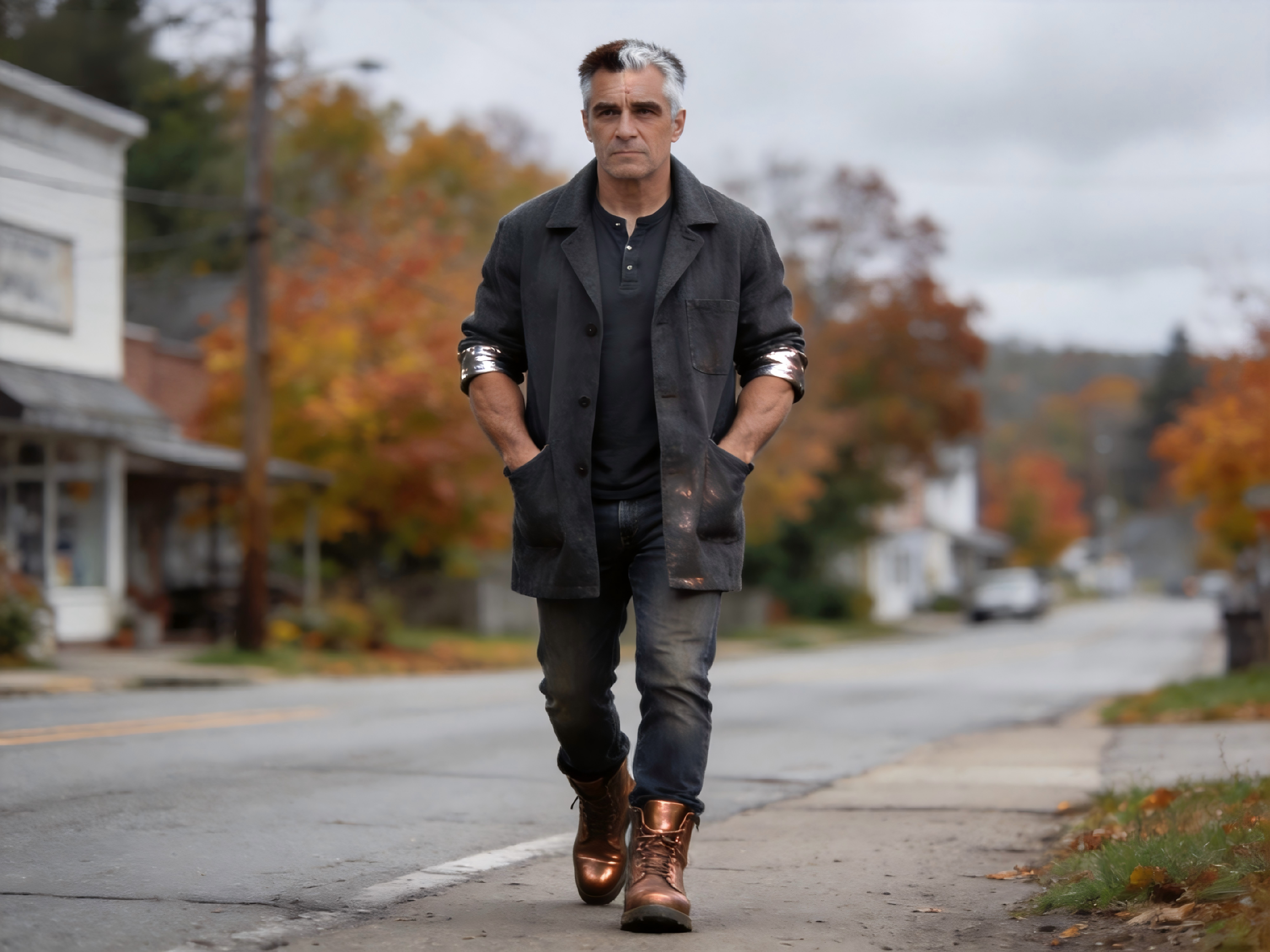
Cal Whitmore | Based Hudson, New York
"The groove wasn't carved by the stone. It was carved by the stone's refusal to stop moving."

15 years running a Heidelberg Windmill letterpress in Brooklyn → printing broadsides and chapbooks, known for a "good bite" → folio edition of a 17th-century devotional text, turns over a proof sheet, sees ghost impression on the back → realizes the ghost (the trace of contact) is more beautiful than the text (the intention) → spends the night looking at the backs of proof sheets → finishes the edition, prints for six more months → walks past the Windmill without turning it on, starts melting beeswax → learns encaustic from a book, a workshop, six months of kitchen failure → moves to Hudson for a former type foundry on Columbia Street → develops his method: build translucent wax layers, drag objects through warm wax, embed fragments as artifacts
Process
birch panel as ground (like a printer's tympan) → building translucent layers of pigmented wax, fusing with heat gun → pressing objects into warm wax and removing them (ghost impressions, grooves, raised lines) → reheating and wiping back (exposing lower layers, creating worn passages) → embedding fragments during the build (letterpress paper, lead type furniture, press blanket thread) → living with the panel, watching how light moves across the traces, knowing it's done when the traces stop surprising
Studio Visit
Press. Trace. Witness.
Everything. A press is a machine for making traces. You apply force to an inked surface and press it into paper, and the paper records exactly what happened — how much force, how much ink, how the type sat in the chase. Every impression is a document of a specific encounter between metal and fiber under pressure. My panels are the same thing in a different medium. I apply heat to wax and drag objects through it, and the wax records what happened — how much pressure, how fast the object moved, how hot the surface was. The wax is the paper. The objects are the type. The heat is the press. And the trace — the groove, the ghost impression, the worn passage — is the proof that contact occurred.
The intention is to make a surface that records passage. The fact that it looks worn is a byproduct, not a goal. I don't set out to make something that looks old. I set out to make something that looks like it's been through something — which is different. An old wall looks old because it's been rained on and frozen and thawed and neglected. My panels look like they've been through something because they have — they've had objects dragged through them, pressed into them, torn out of them, wiped away. The wear is real. It's just not caused by weather. It's caused by me, in a room, on a Tuesday, with a piece of wood and a heat gun. The visual result is similar. The cause is different. I don't find that difference important. A groove in a stone step is beautiful whether it was made by ten thousand feet or by one sculptor with a chisel. The groove doesn't care about its origin story. It only knows it was carved by movement that refused to stop.
Oil paint dries by oxidation. Encaustic dries by cooling. The difference matters. Oil paint stays workable for hours or days, which means you can go back and adjust, blend, correct. Encaustic sets in seconds. Once it's cool, it's fixed — you can't blend it, you can't push it around, you can only add another layer on top or heat it and remove it. This constraint is the same constraint I worked with as a printer: once the impression is made, it's made. You can't un-press a sheet. You can only run it through the press again and hope the second impression corrects the first. I don't want to correct. I want to record. Encaustic records with the same finality as a press impression. The wax sets. The trace is fixed. Move on.
It's evidence. A piece of type-high lead in a panel is not a symbol of my past. It's a physical object from a specific world, and its presence in the wax is a fact — the same way a fossil in a cliff face is a fact. The fossil doesn't symbolize the creature. The fossil is the creature, or what remains of it. The lead doesn't symbolize letterpress. The lead is letterpress — the actual material, the actual weight, the actual object that pressed into paper ten thousand times before it ended up in my panel. I include it because it belongs there. It's what my hands knew before they knew wax. The wax preserves it the way amber preserves an insect. Not as a memorial. As a record.
When the traces stop surprising me. A new panel will do something I didn't expect — a groove will catch light at noon that it didn't catch at nine, a ghost impression will become visible from across the room when the sun hits the window at a certain angle. I watch it. I live with it. When I've learned everything the surface has to tell me — when I can predict what it'll do at any hour of the day — it's done. The traces have told their story. Time to listen to the next panel.
Those are the colors of things that have been through something. Raw umber is the color of soil that's been walked on. Rust is the color of iron that's been rained on. Bone white is the color of something that's been bleached by time. Slate grey is the color of stone that's been worn by water. Cadmium yellow is the color of a new car. I'm not making new cars. I'm making traces. The colors should look like they've earned their place on the panel the way a groove earns its place in a stone step — by being there long enough to matter.
Movement is never just physical. The groove in a stone step was made by feet, yes, but those feet belonged to people who were going somewhere — leaving home, coming home, carrying something, running from something, walking toward something. The groove is a record of all those passages, compressed into a single line in the stone. When I drag an object through warm wax, I'm aware that I'm making a similar record — not of my own passage, necessarily, but of the fact that passage occurred. Something moved through this material. It left a trace. The trace is evidence that the material was not alone. Something was here. Something passed through. That's what a trace says. That's what all my work says. You were not alone. Something moved through you. It left a mark. The mark is the proof.


Professional painters
with enthusiasm and creativity.

Free shipping within the US
by professionals and safe.

Hassle-free returns
within 30 days after delivery.

Secure payments
by credit card and PayPal.